
Batalha, Fátima and Coimbra


There was lots to explore when we arrived at the Monastery of Santa María, in Batalha (above and below), including stunning architecture, ancient crypts and the changing of the guard at the Tomb of the Unknown Soldier.


We began the 7th day of our trip with the realization that the tour was half-way over, and so far, had been just great. Compared to independent travel, we’ve enjoyed not having to deal with our own transportation, skipping the long lines at some of the major attractions, having Fatima and the local guides give us deep personal and historical references for what we were seeing, and most of all, the camaraderie that developed among our fellow travelers. We spent the next two nights in Coimbra, but first we stopped in Batalha to visit the Monastery of Santa María. Once again, the architecture was stunning.
Afterwards, we made our way to the holy site of Fátima. It was Sunday, so we hoped to arrive in time for Mass at the Sanctuary of Our Lady of Fátima. The site is known for the visions of the Virgin Mary seen by three girls in 1917 and is visited by millions of people annually. When we arrived, the open-air plaza was jammed with thousands of pilgrims and the service was just ending. We saw the Statue of Our Lady of Fátima being carried through the crowd and dozens of penitents walking on their knees along a special marble walkway. We’d already seen a number of historic ancient churches, so it was especially moving to see these modern day acts of faith.
The day ended in Coimbra, the former capitol of Portugal and home to the 700-year-old University of Coimbra. We had time to walk around campus and visit the spectacular Biblioteca Joanina. The library holds 60,000 books dating back to the 16th century. As we walked around town, we saw students everywhere. They were easily identified as many wear black capes, a 500-year-old tradition.
The following day began with a special tour arranged for us at Cerâmicas de Coimbra, a ceramics factory on the outskirts of town. Coimbra is well known for its distinctive hand painted ceramics. We got to see the process from start to finish including some hands on with clay. But most incredible was watching the skilled artisans who paint intricate patterns with a steady hand on the ceramics. The owner kindly gifted us each a piece to take home. We appreciated the access to the factory that being on the tour granted us. It’s not something we could have done on our own.
We headed back into town to attend a Fado show. It was our second time hearing Fado on the trip, but we learned that Coimbra style Fado is different than what we heard in Lisbon. Coimbra Fado uses different instruments and is only sung by men, often dressed in the black capes that are the academic tradition of Coimbra. When the performance ended, we shared glasses of Port with our fellow travelers. We had the afternoon and evening free, so we walked along the Mondego River and wandered the streets of Coimbra into the evening, stopping for dinner and ending the day with glasses of Port at a sidewalk table.


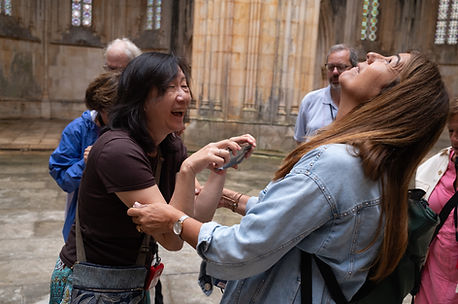
Fatima helped Hey-Jin get the perfect angle for a photo of the ceiling (above) and explained the engineering that went into the building of the Monastery of Santa María (below)

Fátima

We arrived in Fatíma as Mass was ending and we saw a statue of Our Lady of Fatíma being carried through the crowd and dozens of pilgrims walking on their knees as an act of penance, to ask for a favor or to give thanks.


Coimbra

A University student, identified by his traditional academic robe, departs the building housing the Biblioteca Joanina in Coimbra. The library contains more than 60,000 books dating back to the 16th century.

A bust of founder King Dinis I was on display at the University of Coimbra (above) as was a statue of King Dom João III of Portugal who transferred the University to Coimbra in 1537 (bottom right).


We marvelled at the beautiful late afternoon light as we walked along the Mondego River and through the streets of Coimbra, ultimately meeting up with our tourmates for a group dinner where dried, salted cod (Bacalhau) hung in the restaurant (bottom right).


Cerâmicas de Coimbra


Our private tour of Cerâmicas de Coimbra was amazing. We got to meet the proud owner and watch the skilled artisans hand-paint the exquisite details on each piece.


One of our tourmates, Cheryl, tried her hand at tilemaking and came away with all her fingers intact.


We attended our second Fado performance of the week in Coimbra and it was completely different than the Fado we heard in Lisbon, but still stunning. When the performance ended, we were offered glasses of Port (right), which we happily accepted.


We spent most of the afternoon just wandering around the parks and riverfront of Coimbra (above), ultimately finding a late dinner off the beaten path (bottom).


Click the pastel de nata to continue the journey.